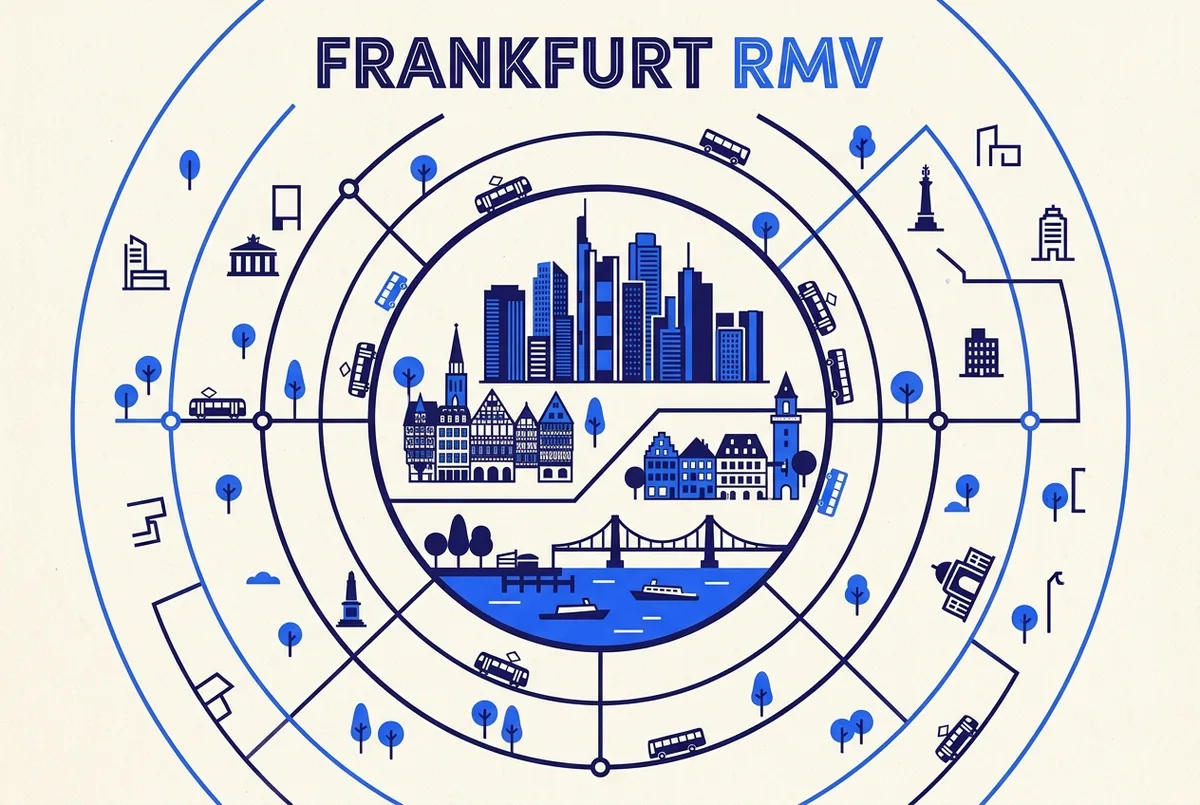
Frankfurt’s public transport tickets run through a single regional authority, RMV, covering trams, buses, the U-Bahn and the S-Bahn across the city and the wider region. The system is genuinely simple once you understand the zone structure, but it trips people up on a first visit because nothing is labeled quite the way visitors expect. Here’s what I’d do: skip the single tickets if you’re moving around more than once or twice a day, and go straight for a day pass instead.
RMV is the regional authority that runs every tram, bus, U-Bahn and S-Bahn fare covered on this page, and its own site and app are the authoritative source for current zone maps and prices.
How does Frankfurt’s RMV zone system actually work?
RMV divides the region into zones, and the fare you pay depends on how many zones your trip crosses. For a visitor staying inside the city center, you almost never leave the innermost zone, which covers the old town, the train station, Sachsenhausen and the river dock all within the same single fare area. I would not worry about memorizing the full zone map; if you’re not leaving the city itself, you’re buying the cheapest fare band by default. This is one small piece of the bigger arrival picture; my full guide to getting to Frankfurt covers the airport and train station side of the trip before you ever reach the question of city tickets.
What’s the difference between a single ticket and a day pass?
A single ticket covers one trip in one direction, with a time limit before it expires. A day pass covers unlimited travel within your zone for the whole day, for a price usually equal to two or three single tickets. I would buy the day pass the moment you know you’re taking more than a couple of trips, since the math works out in your favor almost immediately on a normal sightseeing day that includes a ride out to Sachsenhausen and back.
Where do you actually buy these tickets?
Ticket machines sit at every tram stop, U-Bahn station and inside most trams and buses themselves, and nearly all accept cards alongside cash. I would use the RMV app over the machines if your phone has signal, since it skips any language confusion on the machine’s touchscreen and stores your ticket digitally rather than as a paper slip you need to keep track of. Either way, buy your ticket before boarding, or validate it immediately if the machine issues a stamped ticket rather than a scanned one.
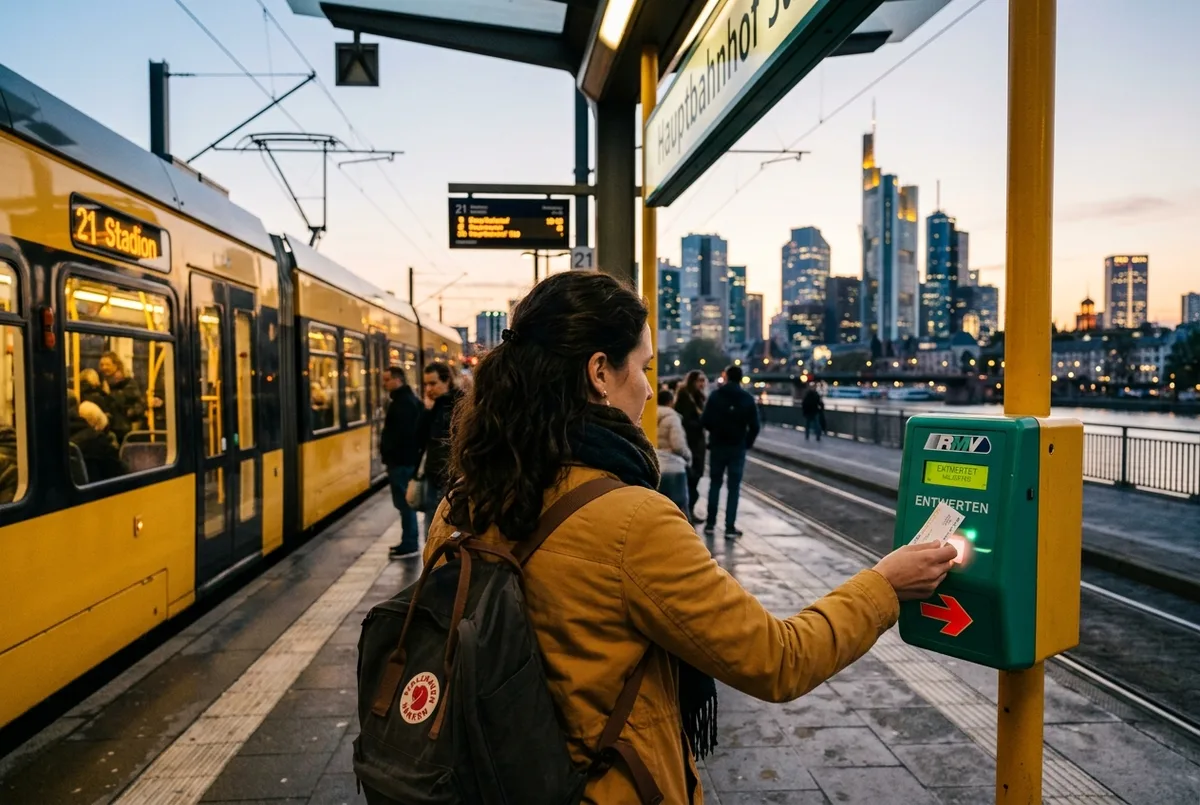
Do you need to validate or stamp your ticket after buying it?
Yes, on some ticket types, and this is a real source of fines for visitors who don’t realize it. Certain paper tickets from machines need a separate stamp from a small validator box on the platform or inside the vehicle before they count as valid. I would always check for a validator near wherever you bought the physical ticket, since an unstamped ticket in a spot check counts the same as having no ticket at all, regardless of whether you actually paid for it. Tickets bought through the RMV app are already validated at the moment of purchase, which is one more reason I’d lean toward the app.
Are ticket checks actually common in Frankfurt?
Yes, more than casual visitors expect. Plainclothes inspectors do spot checks on trams, buses and U-Bahn trains, and a missing or unvalidated ticket results in an on-the-spot fine regardless of whether you intended to pay. I would never ride without a valid ticket assuming nobody checks, since the fine is significantly more expensive than the fare you were trying to save, and inspectors don’t accept an apology in place of payment.
What’s the best single pass for a short, two or three day stay?
For most visitors spending two or three days mostly in the city center, I would buy a day pass for each day you’re actively sightseeing rather than a longer multi-day pass, since the per-day cost rarely improves much at that short a stay. If your trip stretches to four or five days with heavy daily transport use, it’s worth checking RMV’s longer-duration passes at the ticket machine, since the breakeven point shifts in their favor the longer you stay.
Check current availability for the Main River Sightseeing Cruise →
Do you even need a ticket if you’re mostly walking between the old town and the river?
Honestly, maybe not. The old town, the train station area and the Eiserner Steg river cruise dock sit close enough together that a fit traveler can walk the whole core of the city without touching public transport at all. I would only buy a ticket once your plans include Sachsenhausen, a trade fair venue, or anywhere genuinely outside comfortable walking range, since paying for transport you don’t end up using is the easiest way to overspend on a short trip.
Does the ticket you buy for the airport train work for city transport too?
No, and this is worth repeating since it catches people out. The airport-to-Hbf leg runs on regional rail with its own separate fare, distinct from the city zone tickets covered here. I would treat the airport journey and your city-center transport as two separate purchases, and I cover the airport leg specifically, cost and all, in my comparison of train, taxi and transfer options from Frankfurt Airport.
Is there a tourist card that bundles transport with attractions?
Some regional tourist cards bundle public transport with discounted entry to museums and attractions, and whether one is worth it depends entirely on how many paid attractions you’re actually planning to visit. I would do the math before buying one, since a visitor whose main plans are the river cruise, the old town and a Sachsenhausen evening, none of which need a museum discount, often comes out ahead just buying transport tickets directly rather than paying for a bundle built around sights they won’t visit.
How do you get from the train station to the river cruise dock using public transport?
From Frankfurt Hbf, a short tram ride drops you within a few minutes’ walk of the Eiserner Steg, or you can walk the whole route in 15 to 20 minutes if you’d rather skip the ticket machine entirely for that one trip. I would walk it on a dry day, since the route passes straight through the city center and gives you context for the city before you ever reach the water, and save the tram for days when the weather or your schedule makes the extra few minutes matter.
Can children or groups get a cheaper ticket?
Yes, in most cases. RMV generally offers reduced fares for children up to a certain age, and some day pass types extend to cover a small group traveling together on the same ticket rather than requiring everyone to buy separately. I would check the group pass option at the machine or in the app before buying several individual tickets, since a family or small group often saves a meaningful amount by combining onto one pass rather than paying per person by default.
Does the ticket system work the same late at night?
Mostly, yes, though service frequency drops noticeably after the evening rush and some lines run less often or switch to a night network depending on the day of the week. I would check the app for the actual next departure rather than assuming daytime frequency applies if you’re heading back from a late dinner in Sachsenhausen or an evening cruise, since waiting fifteen or twenty minutes for a tram that normally comes every five is a common surprise for visitors who didn’t check first.
Is it worth downloading the RMV app before you even land?
Yes, and I would do this before your trip rather than scrambling for it at the airport. The app handles ticket purchase, route planning and live departure times in one place, and having it set up in advance means you’re not fumbling through an app store download on patchy airport wifi right when you need it most. I would also check that your payment method is added and working inside the app before you travel, since testing that on a stable home connection is far less frustrating than debugging it standing on a cold platform.
My honest take on Frankfurt’s transport system
I think Frankfurt’s public transport is genuinely one of the easier systems in Europe to figure out once the zone concept clicks, and I’d tell a first-time visitor not to overthink it: buy a day pass through the RMV app the first morning you plan more than one trip, validate anything that needs it, and treat walking as the default for anything inside the old town and riverfront core. Once you’re settled into the rhythm of the city, a cruise on the main river is an easy addition to any day’s plan, reachable on foot or by a single tram ride from almost anywhere in the center. If you haven’t settled on where to stay yet, my guide to the best areas near the river is worth reading alongside this one, since your hotel’s distance from the dock affects how much transport you’ll actually need day to day.
Frequently asked questions
Do I need to validate my Frankfurt transport ticket after buying it?
Some paper tickets from machines need a separate stamp from a validator before boarding. Tickets bought through the RMV app are already validated at purchase.
Is a day pass worth it for a short visit?
Yes, almost always, if you’re taking more than one or two trips in a day. The day pass typically costs about the same as two single tickets.
Are ticket inspections common on Frankfurt trams and trains?
Yes, plainclothes inspectors do regular spot checks, and a missing or unvalidated ticket results in an on-the-spot fine regardless of intent.
Can I use the same ticket for the airport train and city transport?
No. The airport-to-Hbf leg runs on a separate regional fare from the city zone tickets covered here.
plan your frankfurt boat tour around your day pass →