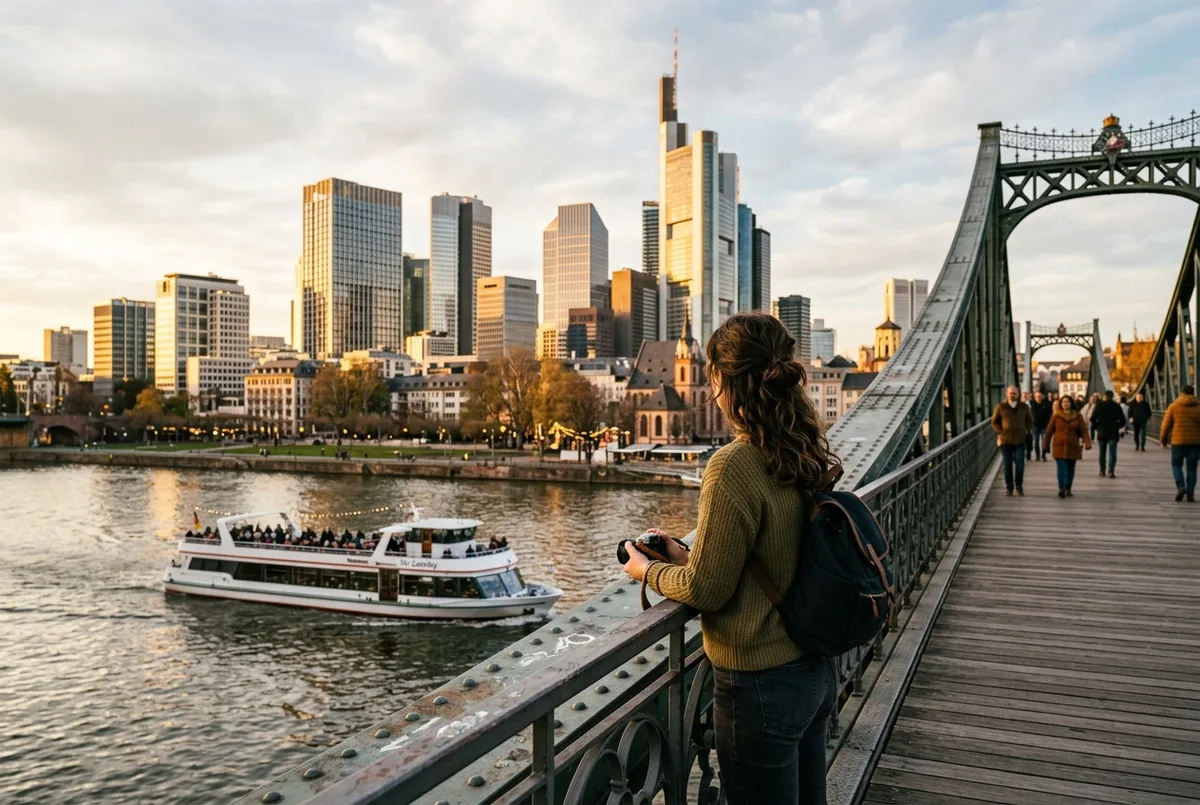
The river that runs through Frankfurt is the Main, not the Rhine. It is easy to see why the two get confused: Frankfurt sits in the wider Rhine-Main region, and most visitors have heard of the Rhine long before they have heard of the Main. Here’s what I’d actually tell a friend booking their first trip: forget the Rhine for your in-city plans. The skyline, the bridges, the riverside walks and every boat tour departing from downtown Frankfurt all run on the Main, and it is worth understanding its route before you decide what to do with it. If you want to see the attribute that ties every river tour in this city together, it is worth comparing what’s actually included in each of Frankfurt’s six river tours before you pick one.
Why do so many people think Frankfurt is on the Rhine?
Frankfurt am Main literally carries the river’s name in its own title, so the confusion usually comes from the region rather than the city itself. The Rhine-Main metro area, Frankfurt Airport’s own “Rhein-Main” nickname, and the fact that the Rhine passes within an hour’s drive all blur together in people’s heads before they arrive.
I’d stop worrying about it the moment you land. Frankfurt’s main river is the Main, full stop, and every bridge, embankment and cruise dock you will actually use on a city visit sits on it. If you specifically want the Rhine, that is a planned day trip out of the city, not something you stumble onto downtown.
What is the River Main’s route through Frankfurt?
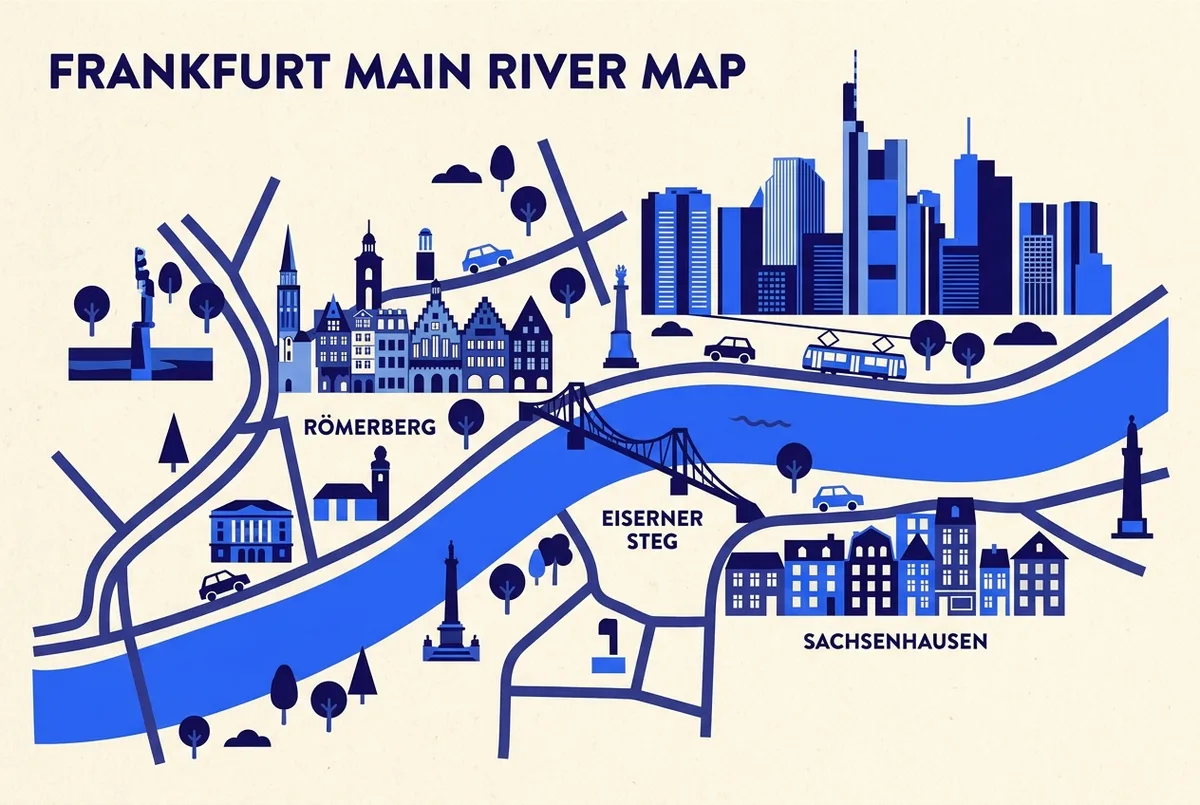
The Main flows roughly west to east through the heart of the city, separating the historic old town and the Financial District on the north bank from the Sachsenhausen district on the south bank. It enters the city from the Taunus foothills, curves past the Westhafen and the old town, then continues east past the Osthafen before eventually joining the Rhine much further downstream at Mainz.
I think this geography matters more than most guides let on, because it explains why the skyline looks the way it does from the water. The skyscrapers cluster right along the north bank, so a cruise heading either direction gives you a long, open view of them across the river rather than a glimpse between buildings.
Which bridges cross the Main in central Frankfurt?
Central Frankfurt has more river crossings than most first-time visitors expect, and each one does a slightly different job.
| Bridge | Type | What it’s known for |
|---|
| Eiserner Steg | Pedestrian footbridge | The city’s iconic crossing, right below Römerberg, and the departure point for the main river cruises |
| Alte Brücke | Road and pedestrian bridge | The oldest crossing point, rebuilt several times, linking the old town to Sachsenhausen |
| Friedensbrücke | Road bridge | A busier, functional crossing west of the old town |
| Flößerbrücke | Pedestrian and cycle bridge | A quieter, modern footbridge popular with runners and cyclists |
| Ignatz-Bubis-Brücke | Pedestrian and cycle bridge | A newer crossing linking the Westend area toward the Deutschherrnviertel |
| Deutschherrnbrücke | Railway and pedestrian bridge | Carries S-Bahn trains alongside a walkway, just east of the old town |
My honest pick for a first visit is the Eiserner Steg. It is not the oldest or the biggest, but it sits at the exact spot where the old town, the skyline view and the boat dock all meet, so you get the most out of five minutes standing on it than on any other bridge in the city.
Why does a Rhine river cruise still depart from Frankfurt at all?
This is the question that trips people up most, and it has a simple answer. Frankfurt sits close enough to the Rhine Gorge, around an hour by road, that day-trip operators run a single combined itinerary: a coach transfer out to the Rhine, a cruise segment on the actual Rhine, and a coach back. The departure point for booking is Frankfurt, but the river you cruise on is not the one running through the city.
I’d book that kind of trip only once you understand this distinction, because it changes your expectations. You are not getting on a boat downtown and sailing to the Rhine; you are being driven to it first. If what you actually want is a river tour that starts and ends inside Frankfurt itself, that is the Main, and the frankfurt rhine river search phrase some people use is really just shorthand for “I want to see a big European river from Frankfurt,” which both rivers can deliver in very different ways.
What does the Main actually look like along the Frankfurt skyline?
The stretch of river right past downtown is genuinely one of the better urban river views in Germany, in my opinion. Heading downstream from the Eiserner Steg toward Griesheim, you pass the Westhafen and the Städel Museum embankment with the Financial District’s towers rising across the water. Heading upstream toward Offenbach instead, the historic Sachsenhausen district and its own museum row sit on one bank while the skyline falls in behind you.
I’d actually argue the upstream direction gives the better photo angle, since you get the full skyline as a backdrop rather than a side-on view of it. Either way, the contrast between a working river, barges still use the Main for freight, and a financial skyline overhead is the single thing that makes this river worth your time at all.
Is the Main river in Frankfurt safe and clean enough to swim or kayak in?
The Main through central Frankfurt is a working, commercially navigated river with locks, barge traffic and a managed water level, so it is not set up as a swimming spot in the city center. Kayaking and paddling are more realistic, mostly outside the busiest downtown stretch, and I’d treat official riverside signage and local clubs as the real authority on current conditions rather than guessing.
If what you actually want is time on the water rather than beside it, a scheduled cruise solves that without you needing to arrange your own boat, permits or gear.
Does the Main ever flood in Frankfurt, and will that affect a cruise?
The Main is a regulated river with locks managing its level, so dramatic flooding in the city center is rare compared with unregulated rivers. After heavy rain or spring snowmelt upstream, the water level can rise noticeably and the current runs faster, which occasionally affects scheduled cruise operations if conditions get genuinely severe.
I would not build a trip around worrying about this. In practice, the two public cruises run their normal hourly schedule the overwhelming majority of the time, and operators simply pause departures on the rare day conditions do not allow it, refunding or rebooking affected customers. If your trip falls during an unusually wet stretch of weather, I would just check the operator’s site on the morning of your cruise rather than assuming the worst in advance.
Are there other rivers or waterways near Frankfurt worth knowing about?
The Main has its own tributaries you will likely never notice as a visitor, but they are worth a mention since they occasionally come up in local context. The Nidda joins the Main from the north on the western edge of the city, and the Nidder feeds into the Nidda further upstream. Neither is relevant to anything you would actually book as a tourist; they are flood-plain rivers with walking and cycling paths rather than cruise routes.
I would not spend any time chasing these down on a short visit. I mention them only because a wider map search sometimes turns up the Nidda and leaves people wondering if they have found a second, lesser-known river tour. They have not. Every boat tour you can book in Frankfurt runs on the Main itself.
How does the Main compare to the Rhine for a first-time visitor?
I’d frame it this way: the Main gives you Frankfurt’s skyline, and the Rhine gives you castles and vineyards. They are not competing for the same trip. The Main is a short, easy, in-city activity you can fit into a single morning or evening. The Rhine is a half-day or full-day commitment that takes you well outside the city.
My honest recommendation for someone with limited time is to do the Main first. It orients you to the city, it is cheap, and it runs hourly rather than on a fixed schedule. Only add the Rhine once you know you have a spare day to give it.
How did the Main shape Frankfurt as a trading city?
Frankfurt grew up around a shallow, fordable crossing of the Main, which is actually where the city’s name comes from: a “ford of the Franks.” Long before the skyline existed, the river was the reason merchants settled here at all, since a reliable crossing point on a navigable river made this the natural spot for trade routes between northern and southern Germany to meet.
I think this history is easy to miss because the modern view is so dominated by glass towers, but the Osthafen and Westhafen, the city’s old and newer harbor districts, are a direct continuation of that same trading function. Barges still move freight along this stretch today, which is part of why the river feels like a working waterway rather than a purely decorative one, even with a financial district rising right behind it. The river’s full course runs considerably further than the stretch any Frankfurt cruise actually covers, picking up several other tributaries before it reaches the Rhine at Mainz.
What’s the best time of day or season to see the river?
Light changes the river more than almost anything else about it. A late afternoon or early evening cruise catches the Financial District’s glass towers lit by low sun, which I’d rate as the single best light of the day for photos. A late morning departure is usually calmer at the dock itself, since the Eiserner Steg gets genuinely busy with tour groups by midday in peak season.
Season matters too, though less dramatically than you might expect. Summer gives you the longest daylight window and the warmest evenings on an open deck. Winter cruises run on the same hourly schedule, but standing on an open-air deck in January is a different experience than in July, so I would dress for the water rather than the old town streets if you are visiting between November and March. Spring sometimes brings higher water levels after snowmelt further upstream, which can occasionally affect scheduled departures, though this is the exception rather than the rule.
Where can you get the best view of the river in Frankfurt?
Land-based viewpoints and the boat itself each show you something different. The Eiserner Steg gives you the classic postcard shot, the Sachsenhausen embankment gives you a lower, closer angle, and mid-river from a cruise gives you the one perspective neither bank can match: both banks at once, with nothing blocking the skyline. If named vantage points and the best time of day for each matter to you, I’ve laid them out properly in my guide to the best spots to photograph the Frankfurt skyline from the Main.
What’s the easiest way to actually see the river up close?
Walking the riverbank gets you close to the water but only ever shows you one side at a time. For the short walk from the old town down to the departure dock, with timing that doubles as pre-cruise orientation, I’d read my walking guide to the Eiserner Steg and the Main riverbanks before you set out on foot. If you would rather be on the water than beside it, the hourly sightseeing cruise is genuinely the simplest option in the city. There is no advance booking strictly required, a choice of up to three route lengths, and departures every hour from the same dock under Römerberg.
Check current availability for the Main River Sightseeing Cruise →
Is there more to do once you know the river?
Once the geography clicks, the practical questions tend to follow. If you are deciding where the operators actually run from and what a ticket costs, I’d read my Primus-Linie Frankfurt guide next, since it covers the schedule and meeting point in detail. And if the river is just one piece of a bigger first visit, my honest take on whether Frankfurt is worth visiting walks through what else the city offers beyond the water.
My honest take on the River Main in Frankfurt
If you remember one thing from this page, make it this: frankfurt main river, not the Rhine, is what you are looking at every time you stand on a bridge downtown. I would not spend any more mental energy trying to reconcile the two. The Main gives you the skyline, the bridges and the boat tours; the Rhine is a separate trip for a separate day.
My practical advice is to walk to the Eiserner Steg at least once regardless of whether you book a cruise, since it costs nothing and takes ten minutes from the old town. Then decide whether the view from a bridge is enough for you or whether you want the wider angle a boat gives you. I’d pick the boat almost every time, mostly because the price is low enough that the choice barely matters, and the open deck shows you the stretch of river no single bridge can.
Frequently asked questions
Does the Rhine flow through Frankfurt at all?
No. The Rhine does not pass through central Frankfurt. The Main is the river running through the city, and it joins the Rhine much further downstream at Mainz.
Why is Frankfurt called Frankfurt am Main?
“Am Main” simply means “on the Main,” distinguishing this city from Frankfurt an der Oder, a separate German town on a different river entirely.
Can you see both the Main and the Rhine in one day from Frankfurt?
Technically yes if you book a full-day Rhine excursion and still have time for an evening Main cruise, but I would not recommend rushing both into one day. Each deserves its own unhurried visit.
Is the Main river in Frankfurt the same width as the Rhine?
No, the Main through Frankfurt is narrower than the Rhine, which is part of why the city’s bridges feel more intimate and the boat cruises feel shorter and more relaxed than a true Rhine cruise.
Does freight traffic still use the Main through Frankfurt?
Yes, the Main remains a working commercial waterway, and it is common to see barges passing through the same stretch a sightseeing cruise covers.
Is the River Main navigable all the way to the Rhine?
Yes, a series of locks keeps the Main navigable for commercial and passenger traffic along its full length until it joins the Rhine at Mainz, which is also why a Rhine cruise departure can be marketed from Frankfurt even though the cruise itself happens on a different river further along the route.
this Frankfurt boat tour along the Main →